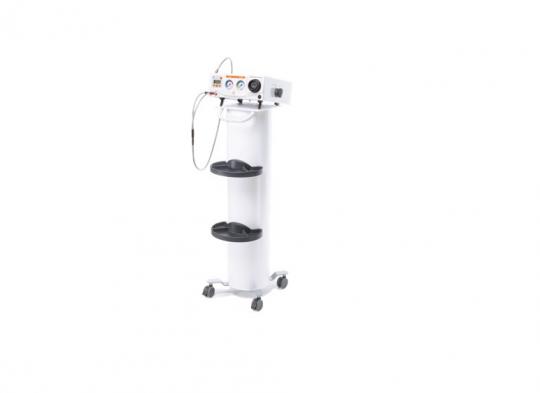
This is a pneumatically operated device – it does not require mains electrical power. The cooling agent used is nitrous oxide (N₂O) or carbon dioxide (CO₂) contained in steel pressure cylinders.
The unit is easy to operate and requires no preparation before the procedure. It can be ready for use within a few seconds.
Once freezing is initiated, the cryoapplicator tip reaches its minimum temperature within seconds, and defrosting of the probe is just as quick.
The device can be used in various medical fields, such as gynaecology, dermatology, and proctology.
Technical specifications
-
No electrical power consumption
-
Cooling agent: Nitrous oxide (N₂O) or carbon dioxide (CO₂). Efficient, easy to use, and safe to store (in steel cylinders). A 10L gas cylinder is sufficient for approximately 60–70 patients. The gas provides low temperatures down to –89°C through expansion inside the cryoapplicators.
-
Gas flow regulation and control (available only in CRYO-S devices). This is a key parameter determining the cryoapplicator’s performance. The volume of gas passing through the cryoapplicator is measured by a flowmeter. The flow rate indicates the condition of the cryoapplicator connected to the device. An optimal flow value ensures effective freezing. Controlling the indicator and outlet gas flow is crucial for maintaining treatment efficiency. Low flowmeter readings may indicate a partially blocked cryoapplicator (e.g. due to dirt or moisture) or low cylinder pressure.
-
Pressure gauge and pressure regulation
After opening the cylinder valve, the internal circuit of the unit is filled with pressurised gas:-
Yellow zone (0–20 bar): cleaning pressure for the applicator tip
-
Blue zone (25–50 bar): standard operating pressure
-
Red zone (60–80 bar): overpressure
-
-
Timer setting and control
-
Measurement of procedure duration
-
Pre-set timing signals with audible alerts
-
The device emits an audible signal every 5 seconds to indicate the passage of time
-
-
Pneumatic power supply system (gas cylinder)