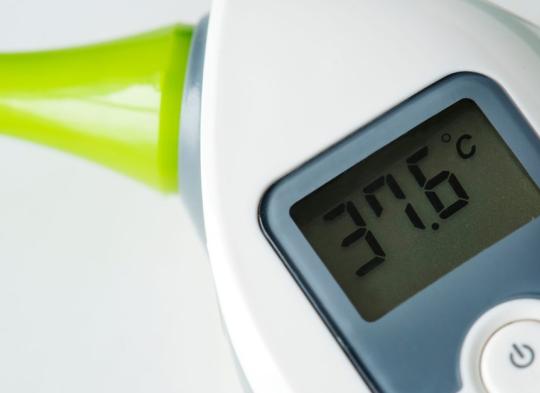
The thermometer shows a fever, and you have just a few minutes to decide what to do next. In the UK, NHS guidance provides a clear pathway: what matters is your baby’s age, temperature and behaviour.
You can read about other common infections in babies in our article “The Most Common Illnesses in Infancy”.
If your baby is under 3 months old and their temperature, measured in the armpit, is 38°C or higher, contact a doctor or call NHS 111 straight away, even if your baby seems well and it is the middle of the night. More details are provided below, but this is the single most important rule.
How to Take Your Baby’s Temperature and What the Thresholds Are
Up to 4 weeks of age, take your baby’s temperature in the armpit using a digital thermometer. After that, you can also use an ear thermometer. In the UK, rectal temperature measurements are not used for babies, and assessment should not be based solely on a forehead temperature reading.
| Age | Threshold | What to do |
|---|---|---|
| Under 3 months | 38°C or higher | Contact a doctor or call NHS 111 today, even if your baby seems well. |
| 3–6 months | 39°C or higher | Call NHS 111. |
| Any age | Fever lasting 5 days or longer | Call NHS 111 or arrange an appointment with a doctor. |
Warning Signs – When to Call 999 and When to Call 111
Call 999 (or go to A&E) if you notice:
- a stiff neck,
- a rash that does not fade when you press a glass against it,
- sensitivity to light,
- a seizure,
- unusually cold hands and feet,
- your baby is drowsy and difficult to wake,
- blue, grey or blotchy skin, lips or tongue,
- a weak, high-pitched or continuous cry, or confusion,
- grunting when breathing, very fast breathing or obvious difficulty breathing (the tummy sucking in under the ribs),
- a bulging fontanelle (the soft spot on the top of the baby’s head),
- your baby is not responding as they normally do or is not interested in feeding or their usual activities.
Call NHS 111 (you can ask for a Polish interpreter) or arrange a same-day appointment with a doctor if your baby:
- is under 3 months old and has a temperature of 38°C or higher,
- is over 3 months old and has a temperature of 39°C or higher,
- has other symptoms in addition to a fever, such as a rash,
- is dehydrated – nappies are not as wet as usual, their eyes appear sunken, or they cry without tears,
- has a sunken fontanelle,
- is eating or drinking noticeably less than usual,
- has had a fever for 5 days or longer.
If your baby has any of the symptoms listed under 999, do not wait – call for emergency help. If your baby has any of the symptoms listed under 111, do not wait – call 111 or contact your GP.
What to Do at Home
The temperature itself matters less than how your baby is behaving - a listless baby with a moderate fever may be more concerning than an active child with a higher temperature. If your baby does not have any of the warning signs listed above, you can care for them at home: give them plenty of fluids, check on them regularly, including during the night, do not undress them completely, and do not try to cool them down by sponging them or using wet compresses. Do not give paracetamol and ibuprofen at the same time and never give aspirin to anyone under the age of 16.
Frequently Asked Questions
Can I Give My Baby Paracetamol Before We Get to the Doctor?
In the UK, paracetamol can be given from 2 months of age (at 2–3 months, provided the baby weighs more than 4 kg and was born after 37 weeks of pregnancy). NHS even recommends it after the MenB vaccinations given at 8 and 12 weeks of age. Ibuprofen can be given from 3 months of age and if the baby weighs at least 5 kg, but it should not be given if the baby has chickenpox or is dehydrated. Never give both medicines at the same time or give aspirin. Fever within 48 hours of the MenB vaccination is common; if it develops later, contact a doctor.
What Is the Most Accurate Way to Take a Baby’s Temperature?
Up to 4 weeks of age, use a digital thermometer in the armpit. After that, you can also use an ear thermometer. Forehead temperature readings may be less accurate, and rectal temperature measurements are not used for babies in the UK.
Medical information correct as of 29 September 2026. This article is for information purposes only and is not a substitute for medical advice – each individual situation should be discussed with a doctor.
Consult a Polish Paediatrician in London
If your baby has any of the symptoms listed under 999 or 111 above, use the appropriate NHS pathway first. If you have an older baby who is otherwise well and has no warning signs, but you are still concerned, our paediatricians see patients in Harrow and Coventry, with same-day appointments available.
Photo: rawpixel / 123RF