Acne is the most common dermatological condition. It is a chronic disease of the hair follicle-sebaceous gland unit, accompanied by increased sebum production.
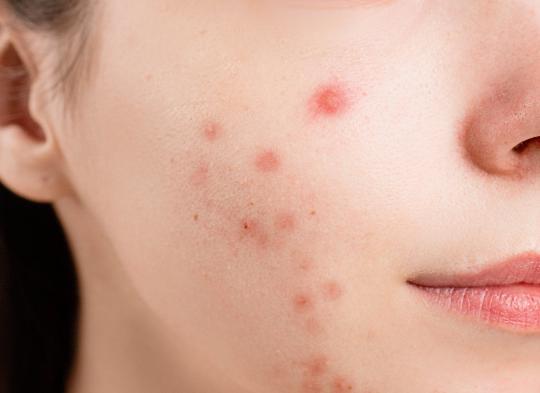
In the clinical picture, polymorphic lesions dominate, including open comedones (blackheads), closed comedones (whiteheads), papules, pustules, nodules, pseudocysts, and sometimes scarring. It affects 85% of males and 80% of females. The disease can occur in adults at any age; about 8% of the population aged 25–34 and 3% aged 35–44 are affected. In 20%, it occurs in newborns and can persist until 2–3 years of age. The duration of acne is unpredictable. In most teenagers, lesions resolve after 3–5 years, but in some, they may last over 10 years.
Pathogenesis
The development of acne results from changes occurring in the body during puberty. Acne is a disease affecting the sebaceous areas, specifically the hair follicle, especially in the location of the pilosebaceous unit (sebaceous-hair). The sebaceous follicles differ from regular hair follicles by having a much larger sebaceous gland. In the etiopathogenesis of acne, the main roles are played by:
- Hormones
- Genetics
- Sebaceous activity
- Bacterial factors
- Hormonal factors
The greatest impact is exerted by androgens—dehydroepiandrosterone sulfate, testosterone, and dihydrotestosterone. The strongest effect is shown by dihydrotestosterone, which is formed from testosterone under the influence of 5α-reductase. Androgens, active during puberty, stimulate both the growth of sebaceous glands and increased sebum secretion. This is not due to increased androgen production but rather a specific hyperreactivity of the sebaceous follicle. In acne patients, hormonal disturbances are usually not observed. The role of androgens in lesion formation is evidenced by the presence of receptors for dihydrotestosterone in the skin, hair follicles, and sebaceous glands, the production of dihydrotestosterone in "sebaceous" skin areas, and the expression of 5α-reductase in sebaceous glands of areas predisposed to acne. Besides androgens, glucocorticoids, ACTH, gonadotropins, exogenous androgens (testosterone), and anabolic steroids also show acneogenic activity.
Sebum in acne
Both excessive sebum secretion and altered sebum composition play a significant role in the formation of acne lesions. The cause of blocked sebaceous glands and inflammatory response is attributed to free fatty acids produced under the influence of lipases released by Propionibacterium acnes. This involves, among others, abnormal keratinization of the excretory ducts, sebaceous glands, and excessive keratinization of follicular openings. As a result, sebum egress from the glands becomes increasingly difficult, and the ducts are widened. Consequently, closed comedones (whiteheads) and open comedones (blackheads) develop.
Role of bacteria
Propionibacterium acnes is currently considered the only bacteria involved in acne, although skin also hosts staphylococci, micrococci, and lipophilic yeasts—Malassezia furfur. P. acnes is a natural saprophyte on human skin, mainly found in sebaceous areas. Its main role in acne is believed to be in initiating inflammatory responses and participating in immune reactions.
Symptoms and course of acne
The basic signs of active acne are:
- Sebum overproduction
- Non-inflammatory lesions (closed and open comedones)
- Inflammatory lesions: papules, pustules, infiltrates, cysts, and fistulas.
The following main forms of acne are distinguished:
- Comedonal acne /acne comedogenica/
- Papulopustular acne /acne papulo-pustulosa/
- Nodular-cystic acne /acne nodulo-cystica/
- Keloid scars /acne keloidea/, which are a consequence of acne lesions.
Rare forms include eruptive acne, excoriated acne, and inverse acne /acne inversa, hidradenitis suppurativa/.
Acne lesions often tend to scar. It most frequently appears on the face (99%), back (90%), and somewhat less often on the chest (78%). However, lesions can also be observed on the limbs (mainly the shoulders) and buttocks.
It is important to remember that acne can be a symptom of many diseases: polycystic ovary syndrome (acne, infertility, menstrual disturbances), SAHA syndrome (seborrhea, acne, hirsutism, hair loss).
Hormonal testing should be performed in adult women with sudden onset of severe acne, especially when the acne is resistant to conventional treatments, in all cases of menstrual irregularities, or when signs of hyperandrogenism are present. The tests should include testosterone, SHBG, androstenedione, DHEA, prolactin, LH, FSH, cortisol, and 17-hydroxyprogesterone.
Factors that worsen acne:
- About 60-70% of girls notice flares before menstruation,
- 10% experience worsening due to foods (especially carbohydrates),
- Stress can intensify clinical symptoms of acne,
- 15% of patients have increased sweating,
- Contact with oils and chlorinated hydrocarbons,
- Improvement with summer UV radiation, but PUVA therapy may exacerbate it.
Proper hygiene is essential in acne management. Excessive, frequent washing (several or more times a day) is not only unnecessary but can worsen the condition.
Certain medications can aggravate acne: anabolic steroids, anticonvulsants, vitamin B12, barbiturates, and some cosmetics.
Acne is an easily recognizable disease, but its treatment is not straightforward.
Key elements of therapy include: adjusting treatment to the clinical form of the disease, applying medications that target all possible etiopathogenic aspects, proper skin care, patient education (understanding the disease process), and good cooperation with the treating physician.
Treating acne
The primary goal is to reduce symptoms and prevent scar formation, which is a significant psychological problem. Acne treatment is chronic. Topical treatment is fundamental.
Topical medications include:
- Retinoids: tretinoin, isotretinoin, adapalene, tazarotene—all can cause irritation (redness, peeling, burning).
These drugs normalize keratinocyte proliferation and differentiation, reducing blockages of the sebaceous duct and facilitating sebum egress. - Benzoil peroxide: acts as a comedolytic and antibacterial agent.
- Azelaic acid: available in 15% and 20% formulations; keratolytic, antibacterial, anti-inflammatory, sebum-reducing, also decreases post-inflammatory hyperpigmentation.
- Topical antibiotics: erythromycin, clindamycin.
- Combination preparations
- Supporting agents: 1-2% salicylic acid, glycolic acid (L-hydroxy acids).
Systemic treatment: hormonal drugs, antibiotics (tetracycline, limecycline, minocycline), macrolides (erythromycin, azithromycin).
Isotretinoin is the drug of choice for the most severe forms of acne—nodular cystic acne resistant to antibiotics and cases with significant sebum overproduction or a high tendency to scarring. During the first 6-8 weeks, skin deterioration may occur temporarily. Side effects include: inflammation of the lips, redness and peeling of the skin, conjunctivitis, teratogenicity, and laboratory abnormalities such as elevated transaminases, triglycerides, and cholesterol.
All content on this website is the intellectual property of Poland Medical Clinic. Copying, reproduction, or dissemination in whole or in part, in any form or manner without the administrator’s permission, is prohibited; any unauthorized use will be considered a violation of copyright laws.